How to attract and hire tech talent in Germany’s competitive market
Insights from 200+ hiring leaders across Germany and the DACH region on how to attract, hire, and retain top tech talent and where most companies go wrong.
01 · Why do tech hires fail and cost your business so much?
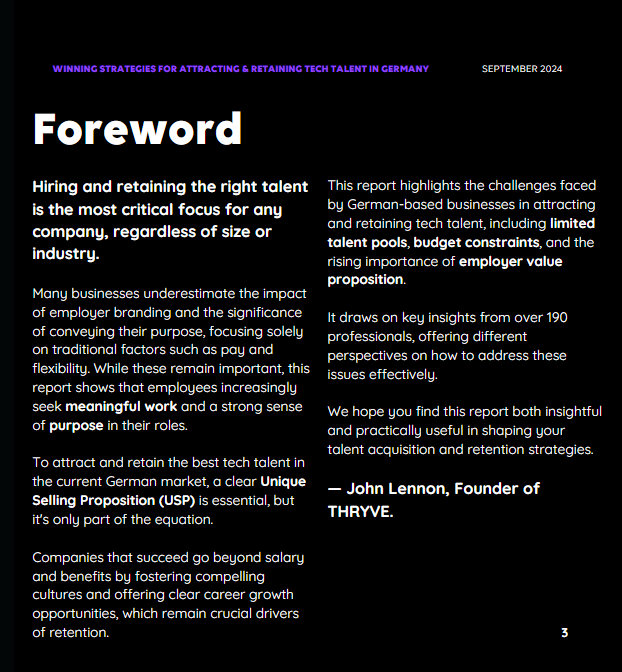
Hiring tech talent within Germany is harder than ever.
Many companies are competing for the same limited talent pool, while still relying on outdated hiring processes. The result is slow hiring, missed candidates, and costly hiring mistakes.
Research shows that bad hires often stay in roles for months, sometimes over a year, impacting delivery, team performance, and long-term growth.
In most cases, the issue is not the candidate. It is the hiring approach.
Many companies searching for ways to improve hiring outcomes in Germany often face challenges around talent shortages, slow hiring processes, and candidate drop-off. These are the exact problems this report explores in detail.
02 · Location & Remote work
Don't let geography limit your recruitment
30%+
In regions where geographic location is a barrier, particularly NRW and Bavaria, where 30%+ of tech leaders cite it as a significant challenge
>15%
remote-first hiring is not optional, it's essential. In Berlin and Munich, fewer than 15% see location as a major obstacle, but the gap matters.
24.5%
of companies that cite geographic location as a challenge also report that remote working significantly impacted their ability to attract talent. However, flexible working is not automatically equal to work-life balance
80%
80% of those who struggle with burnout already offer flexible arrangements. The key is offering it with the right support structures: no-contact hours, check-ins, and genuine autonomy.
03 . Give your employees a reason beyond the job descriptions
Industries like Renewable Energy and CleanTech naturally appeal to this mindset, but any company can create a strong sense of purpose through how they operate, communicate, and engage their teams.
Clear CSR strategies play a key role here. Whether environmental, ethical, or social, they give employees a shared direction and a reason to stay engaged.
The most successful companies bring this to life early. They communicate their vision clearly, involve employees in meaningful initiatives, and support individual contributions through dedicated time or resources.
24.4%
When asked what attracts tech talent, 24.4% respondents selected “other”, with the most common answer being purpose.
04 . Company culture
Company culture was the top factor selected by tech leaders for both attracting (56.1%) and retaining (61%) tech talent. But culture is frequently misunderstood.
The most effective companies create a culture of continuous learning. They run frequent feedback cycles, anonymous surveys, regular one-to-ones, and build inclusivity deliberately, not as an afterthought. They also assess cultural fit during hiring, using values-based interview questions to identify people who will add to the culture rather than hinder it.
56.1%
Said that company culture is a top attraction factor
61%
Said that company culture is a top retention factor
49.2%
Said that career growth opportunities attracts top candidates
61%
Said that job satisfaction retains employees
50%
Said that work-life balance is an attraction and retention factor.
05 . The cost of not paying competitively is higher than you think
Many tech leaders believe budget is the main barrier to hiring.
In fact, 66.8% say budget constraints are their biggest challenge, and over 70% say keeping up with salary expectations is a major issue when it comes to retention.
However, the data tells a different story.
The cost of getting a hire wrong is often far greater than investing in the right candidate from the start. In a THRYVE survey, 35% of companies reported spending over €20,000 on a single bad hire, with some exceeding €100,000.
At the same time, hiring processes are often slow and inefficient. Many German companies take two months or longer to hire, increasing the risk of losing strong candidates or making rushed decisions later.
What should companies be doing differently?
One of the most effective ways to stay competitive is to take a proactive approach to compensation.
Rather than waiting for employees to raise concerns, leading companies review and adjust salaries regularly.
When candidates enter the job market, they often expect a significant increase, which current employers struggle to match.
Staying ahead of this cycle helps reduce attrition, improve retention, and avoid the higher cost of replacing talent.
06 . Why companies work with a tech recruitment partner
When hiring becomes slow, inconsistent, or ineffective, many companies turn to specialist recruitment partners to improve outcomes.
At THRYVE, we help businesses across Germany and the DACH region:
- Hire high-quality tech talent faster
- Reduce the risk of costly bad hires
- Build scalable, high-performing teams
Businesses looking to solve these challenges often work with a tech recruitment partner in Germany to improve hiring speed and quality.
Tech talent partner across Germany, Austria, and Switzerland (DACH)
We have supported over 600 companies in scaling their tech teams and placed more than 2,000 IT professionals. 87% of those hires remain in the business for over 18 months.
All clients receive a carefully selected shortlist of suitable candidates within 5 days.
68%
Of clients use us for more than 5 hires.
21 Days
Average days to fill a permanent vacancy
3 Days
Average days to fill a freelance vacancy
What you’ll learn about hiring tech talent in Germany:
- Why hiring tech talent is so competitive in Germany
- The real cost of a bad hire in tech teams
- What top candidates actually look for in employers
- How to improve your hiring process and retention
- Key hiring trends across Berlin, Munich, and the DACH region
FAQs
Why is it so hard to hire tech talent in Germany?
Demand for skilled tech professionals continues to outpace supply, especially in areas like software engineering, data, and AI. This creates a highly competitive market where companies must move quickly and offer strong value to candidates.
What is the cost of a bad hire in tech?
A bad hire can cost businesses tens of thousands of euros when you factor in salary, lost productivity, and project delays. In some cases, the impact is significantly higher.
How can companies improve tech hiring outcomes?
Improving hiring outcomes requires a structured process, clear role definition, and a strong understanding of what candidates are looking for. Many companies also work with specialist recruitment partners to improve results.